

History of Music Technology
March 04, 2026 - Danny Turner
If one word could capture the driving force behind the pioneering history of music technology, it would be “curiosity” - a desire to shape sound in ways that were previously impossible, and to treat code and circuitry as expressive tools rather than purely technical constructs.
Daisy is deeply rooted in those traditions – not just as a technology platform, but as a continuation of a long creative lineage. But where did this desire to explore the space between systems and sensation begin? Join us for a brief guided tour through the history of music technology to see how we got where we are today.
The Dawn of Music Technology
Remarkably, the first trace of electronic music technology stretches back to 1897 when American inventor Thaddeus Cahill created the first electromechanical musical instrument - the Telharmonium. Cahill was convinced that music could be made with electricity and set about creating an early electrical organ using spinning metal wheels to drive a series of rotating disks, generating electrical waves to produce the twelve basic tones of the musical scale.

The workshop Telharmonium console, source: Wikipedia
Controlled by a keyboard, with the sound transmitted through large paper cones, the final version of the Telharmonium (completed in 1906) weighed 200 tons and retailed at $200,000 – the equivalent of millions of dollars today.
Musique Concrète
The technology behind modern electronic music history can be traced back to the 1940s, when recording advances enabled composers to work directly with captured sound rather than traditional notation. Pioneered by Pierre Schaeffer in Paris, and pivotal to the development of music technology, later in the decade came the compositional style known as musique concrète. Rather than writing music for performers, Schaeffer proposed using recorded sounds as fundamental compositional material.

Pierre Schaeffer with the phonogene in his studio, 1951. Photograph: Serge Lido © INA
These sounds - drawn from musical instruments, the human voice, and environmental noise - were manipulated through techniques such as tape splicing, looping, reversal, and speed variation, marking one of the earliest systematic uses of “found sound” and laying the groundwork for the future development of music technology.
Elektronische Musik
By the early 1950s, musique concrète was contrasted with “pure” Elektronische Musik - developed at WDR studios in Cologne, Germany. Based solely on the use of electronically produced rather than manipulated real-world sounds, composers such as Karlheinz Stockhausen sought to generate music entirely from electronically synthesized tones, relying on early electronic test equipment to produce sine-wave generators, filters, and modulators to construct sounds from basic waveforms. At a fundamental level, this allowed composers to design sonic events with an emphasis on the creation of entirely new sound worlds.
MUSIC
Cited as one of electronic music’s greatest innovators, computer scientist Max Mathews is renowned for creating the first real music program - MUSIC. Devised in the late 1950s while working at Bell Labs, instead of relying on physical oscillators and studio hardware, Matthews treated sound as numbers that could be calculated. In tandem with scientist John L. Kelly Jr, in 1961 the duo used an IBM 7094 mainframe computer to produce the first computer-synthesized vocal performance, Daisy Bell (Bicycle Built for Two). Little did they know that this spark would echo for decades, inspiring technologies like our very own Daisy platform.
Matthews’ MUSIC systems were revolutionary because they proved that a general-purpose digital computer could synthesize sound entirely in software, with the program eventually becoming highly influential and allowing composers to develop much fuller electronic compositions.
Voltage-Controlled Analog Synthesizers
Parallel to Matthews’ rudimentary experiments with music software, the 1960s saw a shift from studio test equipment to the creation of playable electronic instruments. Pioneers such as Robert Moog developed voltage-controlled modular synthesizers with piano-style keyboards, emphasizing traditional playability.

Moog Modular (left) and Buchla 100 Series (right)
Instruments such as the Moog Modular and Minimoog helped integrate electronic sound into mainstream music, while Don Buchla’s simultaneous Series 100 and 200 modular electronic systems rejected conventional keyboard designs in favor of touch plates and experimental control methods that prioritized new ways of shaping sound. With these devices, for the first time in electronic music history, musicians could perform electronic sound in real time, with oscillators, filters, and envelopes becoming defining instrument architectures.
FM Synthesis
Conceived by American musician and Stanford University professor John Chowning in 1967 and formally published in 1973, FM synthesis (Frequency Modulation) uses one oscillator (the modulator) to rapidly change the frequency of another (the carrier), producing complex, bright, or metallic timbres that were difficult to achieve with analog subtractive synthesis.
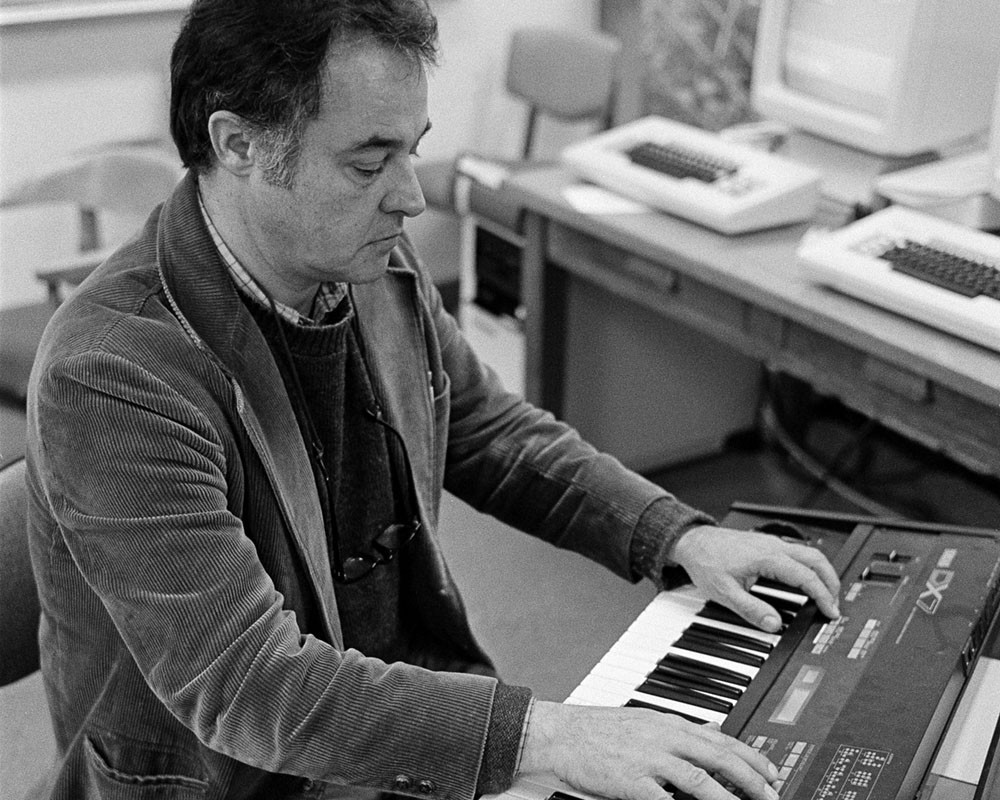
John Chowning playing the Yamaha DX7 Synthesizer at Center for Computer Research in Music and Acoustics (CCRMA). Credit: Chuck Painter / Stanford News Service
Chowning licensed the technique to Yamaha, who used it as the foundation for the DX7 - one of the best-selling synthesizers of all time. Meanwhile, the Synclavier, developed by New England Digital, also employed FM synthesis alongside additive synthesis and, later, sampling. These technologies broke the limitations of analog subtractive synthesis and became foundational to the sound of pop, rock, and electronic music throughout the 1980s.
The Birth of MIDI
As computers became more sophisticated and analog synthesizers were replaced by microprocessor-driven synths that offered more stability and memory, home computers such as the Commodore 64 and Atari ST system helped make computer music easier for the general public to understand, while musicians quickly realized their potential for composing and arranging music.

The Prophet-5: the first commercial musical instrument with embedded microprocessors. Created by MIDI co-founder Dave Smith.
In 1983, this led to the establishment of the Musical Instrument Digital Interface (MIDI) as a commercial standard interface between computers and synthesizers. Crucially, for the first time in the history of music technology, MIDI would revolutionize interoperability between computers and instruments and allow music makers to create without the need for expensive recording studios.
Audio Recording
By the early 1990s, computers that were previously used for sequencing external gear via MIDI finally became capable of full audio recording, marking a transformative milestone in the history of music technology. Steinberg’s release of Cubase Audio for Mac allowed musicians to record, edit, and produce music directly on a computer, giving rise to Digital Audio Workstations (DAWs), while advances in soundcards and software instruments further expanded the possibilities for composers to shape and process audio.

Ableton Live
A decade later, Ableton Live - released in 2001 - would redefine what a DAW could be, blurring the boundaries between studio production and live performance. Its clip-based workflow, real-time looping, and support for virtual instruments and algorithmic plugins positioned the laptop itself as an expressive, performable instrument.
Today and the Future
Even before Live’s arrival, came another quiet revolution: environments built specifically to not just record music, but build the very instruments that make it. Max (later expanded into Max/MSP) popularized visual patching, allowing users to build synths and interactive audio systems by connecting on-screen objects instead of writing code. Pure Data made this approach open-source and widely accessible, while SuperCollider provided a powerful text-based language for high-performance synthesis and algorithmic composition.

Max/MSP
The shift from using instruments to designing them has fundamentally changed electronic music culture. Now, musicians can become instrument builders and software can become both canvas and circuit. Today, embedded audio platforms such as Daisy extend that lineage into the physical world, bringing high-performance, audio-specific hardware into the hands of independent makers.

Daisy, an embedded platform for high-fidelity DSP
Together, these tools continue a decades-long trajectory: steadily lowering the barrier to entry for electronic instrument design and empowering a new generation to not just play electronic music, but invent it.