

How Samplers Changed Music Forever
Danny Turner · 8/17/26
Emerging from the tape-based experiments of the mid-twentieth century and the innovations of musique concrète, music sampling has become one of the most significant technological and creative developments in the history of modern music production.
Unlike synthesizers, which generate sounds electronically, samplers capture real-world audio and transform it into a playable instrument. From chart-topping pop songs to underground hip-hop and blockbuster film scores, the art of sampling has fundamentally transformed how music is composed, performed, and produced.
More than a production tool, sampling has become a transformative medium that continues to redefine music in the digital age. This article traces its evolution from early tape experiments to today's AI-powered tools and open-source hardware.
Where Did Sampling Start?
So where did it all begin? The roots of sampling actually stretch back long before the digital age when composers began wondering how they might be able to capture and manipulate recorded sound as a musical medium. Enter composer, acoustician, and electronics engineer Pierre Schaeffer – often regarded as one of the pioneers of music sampling.
In 1936, after receiving a degree in radio broadcasting, the young Schaeffer began working at France’s public broadcaster and convinced them to allow him to begin experiments in music research and technology (formally called “research into noises”). Founding his first studio at the Radiodiffusion Française in 1942 - equipped with mixers, a direct disc cutting lathe, and a library of sound effects, it was here that Schaeffer laid the groundwork for what would later be termed musique concrète.
More pivotal to sampling, however, was Schaeffer’s meeting with classically trained composer Pierre Henry in 1949. Within two years, the duo would co-found the Groupe de Recherche de Musique Concrète, the first studio designed specifically for electroacoustic music. Over the next decade, the two composers would change the face of music forever by cutting, looping, and reversing tape recordings of everyday noises to create entirely new compositions. It was this tape manipulation that laid the conceptual foundations of modern sampling by demonstrating that recorded sound could be treated as a musical instrument in order to manipulate and replay recorded sounds in new musical contexts.
The Mellotron

The Mellotron M400
Emerging from these tape-based experiments, one of the first commercially successful instruments to bring “sampled” sounds to musicians was the Mellotron. Resembling a retro 1960s electronic organ, rather than using digital memory, the device played back short strips of magnetic tape containing recordings of strings, choirs, and other instruments.
A precursor to the sampler rather than a sampler itself, and despite being prone to mechanical quirks, the Mellotron demonstrated the musical value of triggering recorded sounds from a keyboard, even though the technology was entirely mechanical.
Early Sampling Pioneers
Long before the arrival of the digital sampler, a number of avant-garde composers were exploring the creative possibilities of recorded sound. Among the most influential was Karlheinz Stockhausen, whose pioneering work in electronic music demonstrated that existing sounds could be manipulated into entirely new musical forms.
Through techniques such as looping and micro-composition, Stockhausen constructed complex sonic textures from recorded material, often resampling and replaying them polyphonically. His landmark work Gesang der Jünglinge remains one of the defining achievements of early electroacoustic music and helped establish many of the principles that would later underpin digital sampling.
Around the same time, John Cage and Steve Reich expanded the artistic possibilities of recorded sound in different ways. Cage challenged conventional ideas of musical composition by incorporating collages of taped sounds, radio broadcasts, and phonographic recordings into works such as Credo in Us (1942) and the Imaginary Landscapes series, anticipating the practice of assembling compositions from existing audio sources.
Reich, meanwhile, pioneered tape looping and phasing techniques in minimalist works such as It's Gonna Rain (1965) and Come Out (1966), using repeated speech fragments that gradually shifted out of synchronization. His innovative use of tape manipulation has often been cited as an important influence on modern sampling techniques, profoundly influencing later generations of electronic musicians and producers.
By the late 1960s and early 1970s, many of these experimental techniques had begun to enter popular music. The Beatles, working with producer George Martin and engineer Geoff Emerick, incorporated tape manipulation and found sounds into recordings such as Yellow Submarine and I Am the Walrus, while also borrowing musical phrases from earlier recordings.
Similarly, Pink Floyd used painstaking tape-splicing techniques to create the iconic cash-register loop that drives Money from The Dark Side of the Moon. Although these artists worked decades before an affordable digital sampler became available, their experiments with recorded sound demonstrated that existing audio could be edited, rearranged and transformed into original musical material, laying the conceptual groundwork for what would later become known as music sampling.
Who Coined the Term “Sampling”?
The true breakthrough in music sampling arrived with the advent of digital technology in the late 1970s and instruments such as the Fairlight CMI (Computer Musical Instrument). Introduced in 1979, the Fairlight was the world's first commercially successful digital sampling workstation, combining a digital sampler, synthesizer, and sequencer into one system.
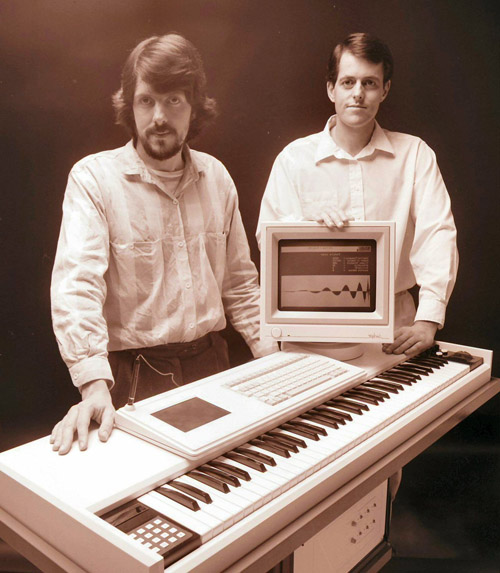
Peter Vogel (left) and Kim Ryrie (right) with the Fairlight CMI
During its development, the Fairlight CMI’s co-creators Peter Vogel and Kim Ryrie discovered that recording a real instrument into digital memory and replaying it at different pitches produced far more convincing results than synthesizing the sound electronically. In 2005, Vogel recalled: “It sounded remarkably like a piano, a real piano. This had never been done before ... By today's standards it was a pretty awful piano sound, but at the time it was a million times more like a piano than anything any synthesizer had churned out. So I rapidly realized that we didn't have to bother with all the synthesis stuff. Just take the sounds, whack them in the memory and away you go.”
Vogel and Ryrie were the first to coin the term "sampling" during the Fairlight’s commercial launch to describe this process of capturing and replaying recorded sounds as musical material. With the advent of the Fairlight, and subsequent digital synthesizers such as the New England Digital Synclavier and E-mu Emulator, musicians were finally able to capture audio in digital form, edit it with unprecedented precision and play it chromatically across a keyboard, forever changing how music was imagined.
How Sampling Democratized Music Production
The advantage of the sampler, and its greatest achievement, was not just that it introduced a new musical technology to the world, but that it made professional-quality music production accessible to anyone. Despite the Fairlight CMI initially costing anywhere between $25,000-$60,000, within a few years the first genuinely affordable sampler - the Ensoniq Mirage (1984) - would offer high-quality sampling capabilities at a fraction of the price, while Akai’s affordable S900, S1000, and MPC60 samplers, would go further by combining a sampler with drum pads and an on-board sequencer.
Whereas creating rich musical arrangements or experimenting with unusual sounds would previously have required access to expensive studios, session musicians, and a vast budget, now a single machine could reproduce drum kits, keyboards, orchestral instruments, and virtually any recorded sound, allowing musicians to build complete tracks from the comfort of a home studio.
In doing so, the rise of affordable samplers shifted creative power away from traditional recording studios and record labels and opened the door to a new generation of bedroom producers, DJs, and underground musicians who could freely experiment and develop their own distinctive sound without having to rely on expensive equipment or formal training.
Hip-Hop and Sample Culture
If there was one genre that embraced the sampler more than any other – it was hip-hop. Its origins can be traced back to 1970s block parties, where DJs such as Clive Campbell, aka Kool Herc, would extend the instrumental “breaks” of funk, soul, and disco records by switching between two copies of the same vinyl.
By isolating, repeating, and recombining sections of existing records using two turntables as a foundation for MCs to rap over, DJs were effectively manipulating recorded sound in the same way that later producers would use digital sampling technology. Herc’s pioneering technique was labeled the "merry-go-round" approach and subsequently gave birth to beat-making and sampling within loop-based dance music.
When affordable samplers emerged in the 1980s, producers gained the ability to capture these breaks, replay them on demand, and manipulate them in entirely new ways. Rather than merely borrowing music, they chopped drum patterns into individual hits, layered multiple recordings together, and transformed fragments of existing songs into original compositions. Suddenly, a few seconds of an obscure jazz record or forgotten soul track could become the backbone of an entirely new musical piece, demonstrating the power of sampling to transform existing recordings into new creative works.
Sampling across Popular Music
Although hip-hop established the sampler as its defining instrument, sampling quickly became one of the most influential creative techniques in modern music. Producers such as Marley Marl, DJ Premier, Pete Rock, and J Dilla transformed fragments of funk, soul, jazz, and R&B into new works using breakbeats, basslines, and vocal excerpts to create a distinctive musical language.
Building on the pioneering turntable techniques of DJ Kool Herc, artists such as Grandmaster Flash demonstrated that existing recordings could become entirely new works, while groups including Public Enemy and their production team, The Bomb Squad, elevated sampling into an art form through densely layered sonic collages.
Meanwhile, in Tokyo, Japan, Yellow Magic Orchestra were among the earliest artists to exploit digital sampling, using a custom-built PCM sampler on Technodelic (1981), while Britain's Art of Noise pushed the creative possibilities of the Fairlight CMI through abstract pop compositions built from vocal fragments, found sounds, and sequenced samples. By the late 1980s, sampling had become central to house, techno, and dance music, with tracks such as Pump Up the Volume helping establish sample-based production as the dominant language of club culture.
Sampling also evolved into a sophisticated artistic practice beyond the dance floor. Beastie Boys demonstrated its creative potential on Paul's Boutique, layering hundreds of samples into complex musical collages, while DJ Shadow created Endtroducing..... almost entirely from pre-existing recordings, proving that an album constructed solely from samples could be both innovative and critically acclaimed.
Today, sampling extends far beyond hip-hop and electronic music. While underpinning genres ranging from pop and rock to jungle, drum & bass, trip-hop, and experimental music, it also plays a vital role in film scoring, television, and gaming. From recreating orchestras with sample libraries to transforming obscure vinyl recordings into entirely new compositions, sampling has become a universal creative technique that continues to shape contemporary music production.
Copyright and Legal Battles
Unfortunately, this creative free-for-all was never going to last. In the early days of hip-hop, producers would routinely sample recordings without permission because the law had yet to catch up with the technology. As a result, dozens of landmark recordings were constructed from unlicensed fragments of existing songs. It was therefore inevitable that as sampling became more commercially successful, copyright owners would take notice, and what had begun as an exciting new artistic tool would soon find itself entangled in legal disputes.
That sea change began in the early 1990s when a series of landmark court cases established that even very short samples would require clearance from both the owners of the original sound recording and the underlying musical composition. As a result, licensing became expensive and time-consuming, forcing producers to reduce their use of recognizable samples. While sampling never disappeared, the carefree, anything-goes approach of the early years was largely over, replaced by a practice shaped as much by legal considerations as creative ones.
The Evolution of Sampling Technology
Over many decades, sampling technology has evolved from expensive, specialist hardware into today’s powerful software that places professional music production within reach of almost anyone. Modern samplers can record, edit, and manipulate audio with extraordinary precision, yet their fundamental purpose remains unchanged: to capture recorded sound and transform it into a versatile musical instrument.
From its experimental beginnings to today’s AI-driven tools, music sampling continues to evolve as both a creative and technological force. Indeed, the next stage of this evolution is being driven by artificial intelligence and cloud computing. AI-powered tools can already identify tempo, pitch, and musical key, separate individual instruments from finished recordings, suggest complementary samples, and even generate entirely new sounds.
However, alongside advances in software, open-source hardware platforms such as Daisy Seed are redefining what a sampler can be. Rather than purchasing a fixed instrument, musicians and developers can build and program their own custom sampling devices and tailor them to specific performances, installations, or creative workflows. This reflects a broader movement toward open, modular, and highly personalized music technology.
Although sampling’s future remains refreshingly open, its essential role is unlikely to change: it will continue to bridge past and present, enabling musicians to preserve, reinterpret, and reinvent recorded sound while continually expanding the boundaries of musical creativity.

